
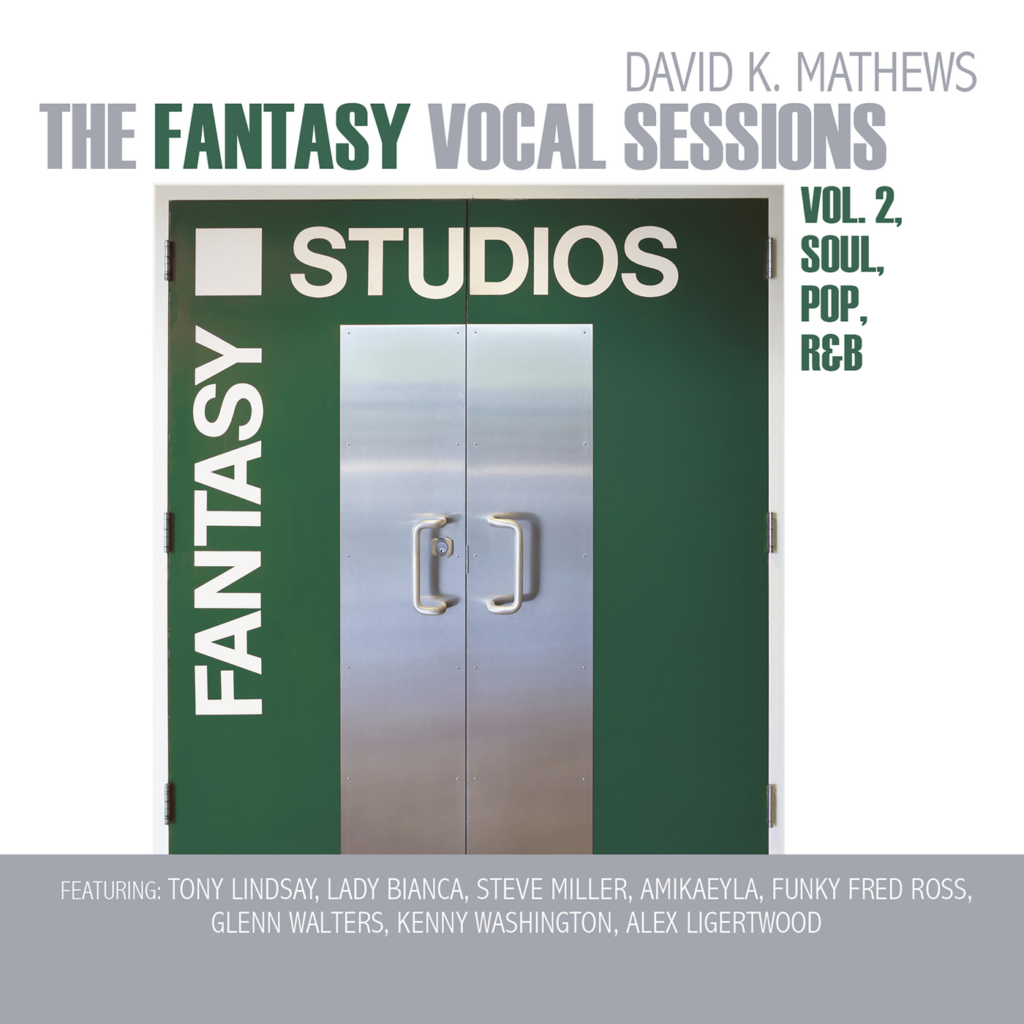
The Fantasy Vocal Sessions, Vol. 2
Available on CD/Digitally
There are countless ways to express gratitude. For David K. Mathews, the veteran Bay Area pianist, organist and keyboardist, the recording studio seemed like an ideal vehicle for crafting an extended love letter to the scene that’s nurtured and inspired him for four decades. A companion to 2017’s critically hailed The Fantasy Vocal Sessions Vol. 1, Standards, the second volume showcases many of the same brilliant Bay Area singers (and a much larger cast of players). But instead of concentrating on American Songbook standards through the lens of straight-ahead jazz, this album offers a deep dive into the Great American Soulbook with a particular focus on songs defined or written by Donny Hathaway, Stevie Wonder, Ray Charles and James Brown. It’s a communal celebration, a welcoming stage with an encompassing spotlight. “Everyone gets a little taste,” says Mathews.

The Fantasy Vocal Sessions were born out of Mathews' desire to record a project with Etta James, the R&B icon with whom he spent two decades touring. When her failing health derailed the collaboration, Mathews decided to seize the moment, inviting a diverse cast of musicians into West Berkeley’s Fantasy Studios for the initial sessions. He included some genuine hitmakers in the mix, but Mathews wanted to highlight some of the region’s most extravagantly under-celebrated artists. The subtitle for the albums could easily be Hidden Gems.

The project’s double-barreled name refers to both the iconic and now-shuttered studio and to the recordings themselves. “They’re the Fantasy Sessions and it’s my fantasy too,” Mathews says. “It’s my thanks for being able to grow up in this wonderful and culturally diverse place, and it’s my love letter to all of my musical brothers and sisters who have inspired me throughout my long career in the Bay Area music scene.” And there’s more to come, with at least another album’s worth of material from the initial marathon four-day Fantasy session in May 2016. Sadly, “volumes 4 and 5 will be recorded elsewhere,” he says.

While Mathews played with swinging authority on Vol. 1’s standards, he’s truly at home on Vol. 2’s soul and R&B anthems. As a kid coming up on the 1970s Bay Area music scene, he soaked up the blues at Berkeley’s Telegraph Avenue dive Larry Blake’s with Tim Kaihatsu. He acquired a deep feel for the Bay Area’s trademark blend of Latin soul working with Pete and Sheila Escovedo (aka Sheila E) and guitarist Ray Obiedo (the Fantasy Sessions’ co-producer and mix engineer). And Mathews bathed in East Bay grease during his 2 year run with Tower of Power. Whether he’s playing piano, Hammond organ, Fender Rhodes or synthesizer, his roots in the R&B bedrock are evident throughout the album, which opens with Amikeayla Gaston’s serenely soulful version of the Isley Brothers’ hit “For the Love Of You.”

She displays a whole different toolkit on Stevie Wonder’s “Superwoman,” shifting gears seamlessly through the song’s contrasting sections, while Mathews tips his hat to the genius of Music Of My Mind by evoking the landmark album’s famously layered keyboard textures. The first half of the diptych also features a beautifully calibrated solo by guitarist Carl Lockett, an important and somewhat underground Bay Area guitar legend. “I was blown away with his playing from the first time I heard him with Bill Bell at Erle’s Solano Club around 1983,” Mathews says. “He sounded like Wes and George Benson.” A lyrical fretless bass solo by another longtime musical friend, current TOP bassist Marc van Wageningen, propels “Superwoman” as Gaston soars through the piece’s second half.

Gaston is at her most unfettered redesigning Jimmy Webb’s “Wichita Lineman,” a rendition no less beautiful for its reconfigured melody. “She’s a beautiful woman with a fearless improvisational ability, and the gift that really great singers have: to deliver the message,” Mathews says. “The song might not be in her key, but she’ll remake the melody, and nothing is lost
in the interpretation because of her phenomenal ears and total commitment to the story.” Gaston is shadowed by another graceful Marc VW bass solo, his first recording following the devastating Oakland train accident that also sidelined his TOP bandmate, David Garibaldi.

Rock and Roll Hall of Famer Steve Miller steps out on the classic Ray Charles number “One Mint Julep,” an arrangement that opens and closes with Quincy Jones famous 1961 chart, (with stealth cameos by John Witala and Vince Lateano) sandwiching a roots-rock groove laid down by longtime Robert Cray drummer Kevin Hayes, part of an illustrious Bay Area music family. Miller’s confident delivery of the rarely heard lyric, backed by Mathews’ deeply funky organ, presents him in a whole new light.

Top-shelf Bay Area soulman Funky Fred Ross evokes another era-defining legend, pouring some fresh whiskey into Papa James Brown’s old bag “I Feel Good,” a song Mathews knew he could step into “as Fred and I have done a lot of JB material together with Pee Wee Ellis and Fred Wesley over the years.” The arrangement is an alternate and somewhat underground JB version from the early 70s that certain funksters in the know have been listening to for a while, a performance energized by TOP guitar great Bruce Conte and ex Herbie Hancock & the Headhunters guitarist Ray Obiedo, two of the finest funk rhythm guitarists in the business.

The spirit of Donny Hathaway reappears on Van McCoy’s “Giving Up,” a tune he wrested from Gladys Knight on his eponymous 1971 album. In much the same way, Lady Bianca positively owns the song with a rendition so commanding it feels like McCoy wrote it with her in mind. “She has the kind of power and believability that reminds me a lot of my beloved Etta,” Mathews says. “We go back a long ways to when I was a very young and green keyboard player tiptoeing my way through the Oakland soul and blues scene. She’s a super-badass treasure.”

Well-traveled rock belter Alex Ligertwood delivers the kind of potent vocals he’s known for on a slow-burning “I Love You More Than You’ll Ever Know,” Al Kooper’s anthem from Blood, Sweat & Tears’ 1968 debut album Child Is Father to the Man.

On the 1964 Little Anthony and Imperials hit “Goin’ Out of My Head,” Glenn Walters’ gravelly gravitas transforms an ode to the quintessential teenage crush into an anguished plea.

And in a final hat tip to Hathaway, the inimitable Kenny Washington - “the greatest male jazz singer in the world,” Mathews says - borrows from the late soul maestro for his rendition of “Yesterday.” Mathews concludes the album with an extended 12-minute workout featuring some hair-raising interplay between Washington and the band. As Ray Charles summed up with mathematical precision: genius + soul = jazz.

In many ways, the Fantasy Sessions embody Mathews’ determination to give back to a scene that’s given him so much. After working his way through the funk and R&B ranks with ever more high profile gigs, he landed an ultimate dream gig with Etta James in 1990. When her declining health kept her off the road, Mathews found himself short of work and scuffling until a timely call came in the summer of 2010 and he took over the Santana keyboard chair (once again following in the footsteps of his B-3 hero Chester Thompson, whom he’d replaced in Tower of Power three decades earlier). He’s been on the road with Carlos ever since, and when Fantasy Studios offered Mathews a rate he couldn’t refuse, the keyboardist jumped at the opportunity to record with a dazzling collection of vocalists. Everyone should know their names and their games.
Track List
- For the Love of You [07:04]
- You Had to Know [05:58]
- One Mint Julep [05:03]
- Superwoman (Where You When I needed You) [10:04]
- So Sweetly [05:21]
- I Got You (I Feel Good) [04:28]
- Giving Up [07:03]
- Going Out of my Head [05:01]
- Wichita Lineman [05:32]
- I Love You More Than You’ll Ever Know [06:14]
- Yesterday [11:31]
Credits
Vocalists: Lady Bianca, Amikaeyla Gaston, Alex Ligertwood, Tony Lindsay, Steve Miller, Funky Fred Ross, Glenn Walters, Kenny Washington
David K. Mathews: Producer
(P) 2020 David K. Mathews
(C) 2020 David K. Mathews